

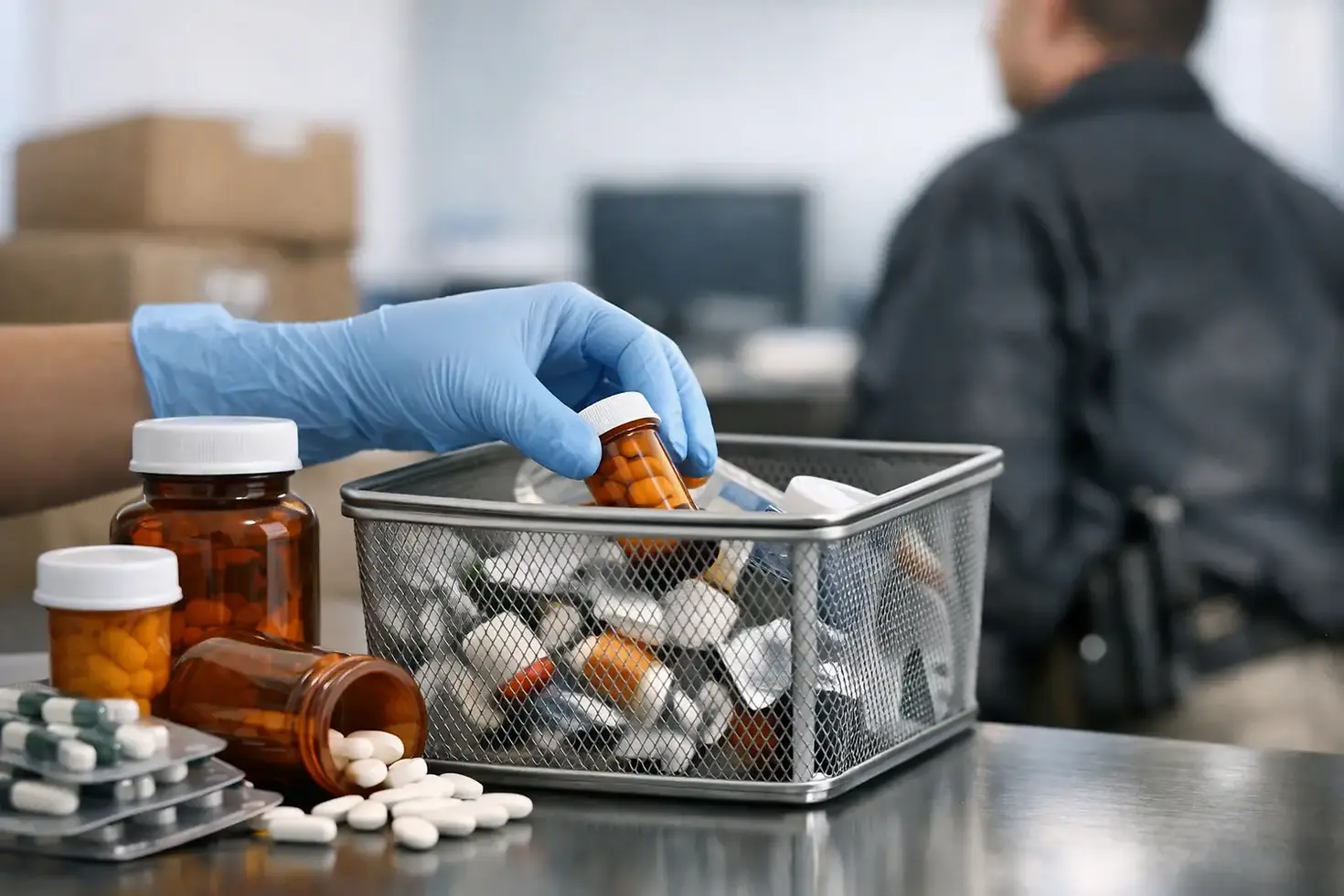
Reverse Distribution: Your Controlled Substances Don't Stop Being Your Problem When You Put Them in the Return Bin
Expired. Damaged. Recalled. Discontinued. Unwanted. Whatever the reason, controlled substances that are no longer being used still have one very important thing in common: they are controlled substances.
Putting them in a box labeled "returns" doesn't magically make the DEA responsibility disappear. Unfortunately, compliance doesn't work quite that conveniently. Until a controlled substance is properly transferred and ultimately disposed of through an authorized process, you are still responsible for knowing where it is, who has access to it, how much you have and what happened to it.
This is where reverse distribution comes in.
So, What Exactly is Reverse Distribution?
Reverse distribution is the regulated process of transferring controlled substances that are no longer suitable for normal dispensing, administration, or distribution to an appropriately authorized reverse distributor for return, processing, and destruction.
This can include expired products, damaged products, recalled inventory, discontinued products, and other controlled substances that are unusable or unwanted.
Sound simple enough, right?
Well...this is where I remind everyone that "simple" and "controlled substances" don't always belong in the same sentence.
The goal is straightforward: once a controlled substance is removed from usable inventory, you should be able to follow its trail all the way through the transfer process.
You should be able to answer:
1. What was removed?
2. How much was removed?
3. Why was it removed?
4. Who removed it?
5. Where was it stored?
6. Who had access to it?
7. Who prepared the transfer?
8. Who received it?
9. What documentation supports the transfer?
10. Did the receiving party actually receive what you say you sent?
If you can't answer those questions without hunting through five different systems and calling three employees who all say, "I think that's how we do it," you may have a problem.
Why Does Reverse Distribution Get DEA Attention?
When investigators review a controlled substance program, they aren't looking at reverse distribution in isolation. They're looking at the bigger picture:
Can you account for your controlled substances?
An expired product is still part of the accountability until it is properly transferred or destroyed. For example, let's say your records show that 100 units were removed from active inventory for reverse distribution. Your transfer documentation shows 100 units, but the receiving documentation shows 96.
Where are the other four?
Maybe someone made a counting error. Maybe there was a data-entry mistake. Maybe the package contained a different quantity than what was recorded. Maybe there was an issue with a partial container. There could be a completely innocent explanation, but here's the important part:
You need to know what that explanation is.
"I'm sure it's fine" is not an inventory reconciliation and writing it off because the product was "just being returned anyway" is definitely not a control.
Don't Let Your Return Area Become the Controlled Substance Bermuda Triangle
One of the easiest weaknesses to overlook is the area where controlled substances are stored while waiting for reverse distribution. You know the area I'm talking about...
The bin
The cabinet
The shelf
The mysterious box in the back room that everyone knows contains "stuff we're sending back."
That's where things can get interesting.
Controlled substances awaiting reverse distribution should be appropriately secured and access should be limited to authorized personnel. The organization should know what is in that area and why it is there. Segregation shouldn't mean "we moved it somewhere and forgot about it."
Your records should still identify the drug, strength, dosage form, package size, quantity, date it was removed, reason for removal, and the person who performed the removal.
If your system requires an inventory adjustment, returns log, or other supporting record, that documentation should be maintained as part of the overall accountability trail.
Additionally, please record actual quantities. "One bottle" isn't always enough. One bottle of 30 tablets and one bottle of 100 tablets are both technically "one bottle." They're also very different quantities.
Details matter.
Verify Who You're Sending It To
Here's another area where I don't recommend taking anyone's word for it. A reverse distributor isn't simply a company that sends you a shipping label and tells you where to put the box.
Before transferring controlled substances, verify that the receiving entity has the appropriate DEA registration and authority for the activity being performed.
Also, make sure you understand what documentation is required for the particular controlled substance and schedule involved. For Schedule I and II controlled substances, transfer documentation requirements are more formal and commonly involve DEA Form 222 or CSOS. Scheulde III through V transfers have their own recordkeeping requirements. The important takeaway?
Don't build your process around "that's how we've always done it."
Registration status, business names, locations, vendors, and procedures can change.
Your compliance program should change with them.
The Chain of Custody Doesn't End at the Shipping Dock
The period between removing a controlled substance from inventory and receiving confirmation that it was received is a critical part of the process. During that time, the product should remain appropriately secured.
If packages are staged for pickup, your procedures should address:
Where packages are stored
Who has access to them
How long they can remain there
Who verifies the shipment
Who releases the package
What documentation is retained
You should also retain the records necessary to support the transaction, including applicable transfer documentation, shipment information, carrier documentation when appropriate and proof of receipt.
The goal isn't to create paperwork just for the sake of creating paperwork. The goal is to create a clear, unbroken trail of accountability.
Basically, if I were to walk in tomorrow and say, "Show me what happened to this controlled substance," you should be able to show me...and preferably without breaking into a cold sweat. 😂
Don't Stop at "Delivered"
This one is important.
A shipping confirmation saying "Delivered" is not necessarily the end of your compliance responsibility. You should reconcile the reverse distributor's receipt documentation against your internal records and the original transfer documentation.
Compare things like:
Drug identity
Schedule
Strength
Dosage form
Package configuration
Quantity
Disposition status
If something doesn't match - investigate it. Don't automatically assume that the problem belongs to the vendor. Maybe the quantity was entered incorrectly. Maybe someone counted a partial container incorrectly. Maybe the wrong package size was recorded. Maybe documentation is missing. Or maybe there is something more significant going on.
The point is that you won't know until you investigate.
Someone Needs to Own the Process
Another common problem with reverse distribution is that responsibility gets spread across multiple departments. Purchasing handles one part. Pharmacy handles another. Receiving handles another. Someone else prepares the shipment, and eventually someone in compliance is asked, "Can you find out what happened to this?"
That's not a great system - a stronger process clearly assigns responsibility.
For example, one employee may identify and prepare the product. An authorized individual may verify the records and execute required documentation. A manager or compliance representative may review reconciliations and investigate exceptions.
The exact structure will depend on the organization, but the principle is the same:
There needs to be accountability at every step, and training should be specific to the employee's role.
"Follow DEA regulations" isn't really training. Employees need to know what qualifies for reverse distribution, how quantities should be recorded, where products are stored, who they should notify, and what to do when something doesn't match.
Test Your Process Before an Inspector Does
One of my favorite ways to evaluate a controlled-substance process is simple:
Pick a transaction and follow it.
Start with the original inventory. Find the product that was removed. Find the record showing the removal. Find where it was stored. Find the transfer documentation. Find the shipment information. Find the receiving documentation. Then reconcile the entire transaction. Could you produce the records quickly? Does the quantity trail make sense? Could someone who wasn't involved in the transaction understand what happened? If the answer is no, that's worth paying attention to.
And don't just test the easy transactions.
Test the exceptions.
What happens when:
A pickup is delayed? The shipment arrives with a discrepancy? An expired product is discovered in active inventory? A partially used container is awaiting transfer? Documentation doesn't match the physical quantity?
Routine transactions can make a compliance program look great.
Exceptions are where you find out how good the program really is.
Reverse Distribution Is About Accountability
At Veritas Compliance & Analytics, I look at reverse distribution through an enforcement-informed lens.
Not just: Do you have a policy?" But: Does the policy actually work? Can your employees follow it? Are controlled substances secured while awaiting transfer? Are the records complete? Can you reconcile what left your inventory with the receiving party says it received? More importantly - can you identify and address a problem before someone else finds it for you?
A controlled substance doesn't stop being your compliance responsibility simply because you've placed it in a return bin. Treat reverse distribution as a documented transfer of accountability.
Verify each handoff, maintain the records, reconcile the final receipt, and when something doesn't make sense, investigate it.
At the end of the day, when it comes to controlled substances, "We sent it back" is the beginning of the explanation - not the end.


Comments